
Respect the Pull — The Smart Traveler’s Guide to Spotting and Escaping Rip Currents
The ocean is magnificent, majestic, and entirely uninterested in your swimming ability. While crashing shore breaks get all the dramatic soundtrack music in movies, the real heavyweight champion of beach hazards is the silent, deceptive rip current.
Rip currents account for over 80% of lifeguard rescues at surf beaches worldwide. The good news? You do not need an advanced degree in oceanography to outsmart one. You just need to know what to look for, how they work, and what to do if you suddenly find yourself on an unscheduled scenic cruise out to sea.
What Exactly Is a Rip Current? (No, It’s Not an "Undertow")
First, let's clear up an old myth: rip currents do not pull you underwater. There is no mythical sea monster lurking beneath the sand dragging swimmers down into Davey Jones’ locker.
- The Mechanics: Waves push water up onto the beach. That water collects, builds pressure, and has to find a path back out to sea.
- The Funnel: It takes the path of least resistance—usually a deeper channel carved into a sandbar or between reefs—and rushes back out in a narrow, fast-moving band of water.
- The Speed: A powerful rip current can travel at speeds of up to 5 to 8 feet per second. That is faster than an Olympic swimmer in a high-tech swimsuit.
Because rip currents pull you horizontally away from shore—not vertically down—the danger is never the water pulling you under. The danger is exhaustion caused by panic.
How to Spot a Rip Current from the Shore
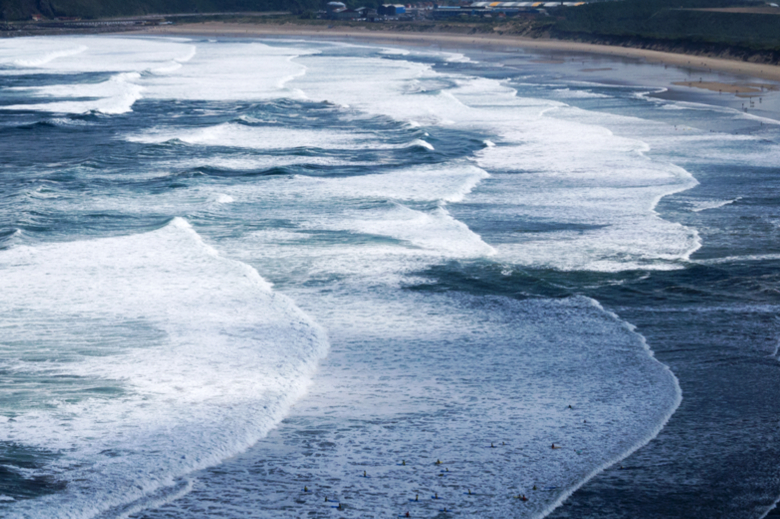
Spotting a rip current before you plunge into the surf is the ultimate travel flex. The irony? Rip currents often look like the calmest, safest place to take a dip. While waves are breaking noisily to the left and right, a rip often looks like a peaceful, flat gap in the surf.
Before unrolling your towel, stand on a high vantage point (like a dune walkway or beach access ramp) for a couple of minutes and look for these telltale signs:
- Discolored Water: A darker, churned-up channel of water caused by sand, sediment, and seaweed being pulled off the seabed.
- A Gap in the Breaking Waves: Waves break where the water is shallow. If you see a consistent line of breaking white foam with a calm, flat gap in the middle, that gap is likely a deep-water rip channel.
- Foam Moving Seaward: Surface debris, foam, or seaweed floating steadily away from the beach in a straight line out past the breakers.
- Choppy, Rippled Surface: A distinct patch of agitated, crisscrossing surface water surrounded by smoother swell.
What to Do If You Get Caught: The 3-Step Playbook
Let’s say you were enjoying the swell, spaced out for two minutes, and suddenly realize your beach umbrella looks like a tiny speck in the distance. Do not panic.
1. Flip and Float
- Turn onto your back, relax your shoulders, and float.
- Conserving your energy is priority number one. Fighting a rip current head-on is like trying to run up a downward escalator set to maximum speed—you will tire out long before the escalator does.
2. Swim Parallel to the Shore
- Rip currents are typically narrow—often only 30 to 100 feet wide.
- Never swim directly against the current back to the beach.
- Instead, swim parallel to the shoreline across the direction of the flow. Once you feel the outward pull subside and you see waves breaking around you again, angle your swim diagonally back toward the sand.
3. If You Can't Escape, Signal
- If you are fatigued or the current is exceptionally wide, continue floating on your back to conserve your breath.
- Face the beach, raise one arm steadily in the air, and call for help. Lifeguards and surfers are trained to spot that universal distress signal immediately.
Beach Smarts: Golden Rules for Ocean Swimmers
A day at the coast should end with fresh seafood and a sunset drink, not an emergency vehicle escort. Keep these simple rules front of mind:
- Swim Near a Lifeguard: Your odds of drowning at a beach protected by certified lifeguards are roughly 1 in 18 million. Those are fantastic odds.
- Heed the Warning Flags: Green means calm; yellow means moderate hazard; red means high hazard (rough conditions/strong currents); double-red means the water is closed. If you see red flags flying, that is your cue to stick to the beach bar.
- Never Swim Alone: Even experienced ocean swimmers use the buddy system. A sudden cramp or surprise set of waves is much easier to manage when someone has your back.
- Keep Inflatables in the Pool: Inflatable pool flamingos and air mattresses act as giant sails on open water. A light offshore breeze combined with a rip current can carry an inflatable out to deep water in seconds.
Respect the ocean’s rhythm, scan the water before you dive in, and let physics do the hard work if you ever find yourself caught in the flow.