Respect the Pull — The Smart Traveler’s Guide to Spotting and Escaping Rip Currents
The ocean is magnificent, majestic, and entirely uninterested in your swimming ability. While crashing shore breaks get all the dramatic soundtrack music in movies, the real heavyweight champion of beach hazards is the silent, deceptive rip current.
Rip currents account for over 80% of lifeguard rescues at surf beaches worldwide. The good news? You do not need an advanced degree in oceanography to outsmart one. You just need to know what to look for, how they work, and what to do if you suddenly find yourself on an unscheduled scenic cruise out to sea.
What Exactly Is a Rip Current? (No, It’s Not an "Undertow")
First, let's clear up an old myth: rip currents do not pull you underwater. There is no mythical sea monster lurking beneath the sand dragging swimmers down into Davey Jones’ locker.
The Mechanics: Waves push water up onto the beach. That water collects, builds pressure, and has to find a path back out to sea.
The Funnel: It takes the path of least resistance—usually a deeper channel carved into a sandbar or between reefs—and rushes back out in a narrow, fast-moving band of water.
The Speed: A powerful rip current can travel at speeds of up to 5 to 8 feet per second. That is faster than an Olympic swimmer in a high-tech swimsuit.
Because rip currents pull you horizontally away from shore—not vertically down—the danger is never the water pulling you under. The danger is exhaustion caused by panic.
How to Spot a Rip Current from the Shore
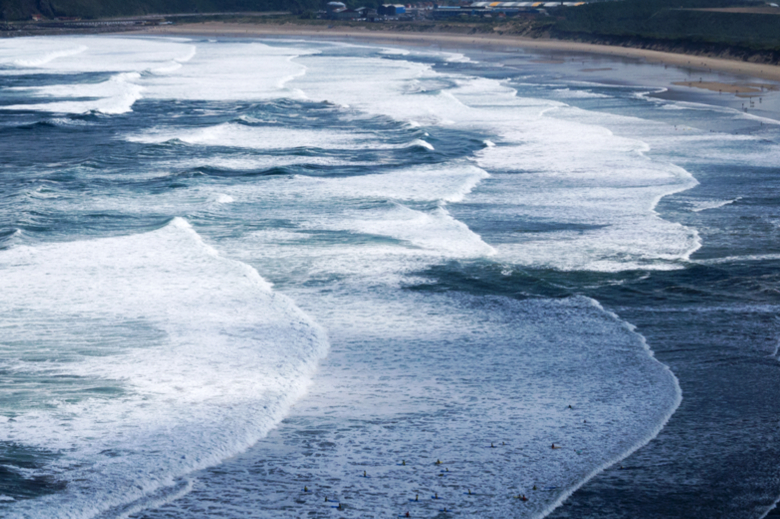
Spotting a rip current before you plunge into the surf is the ultimate travel flex. The irony? Rip currents often look like the calmest, safest place to take a dip. While waves are breaking noisily to the left and right, a rip often looks like a peaceful, flat gap in the surf.
Before unrolling your towel, stand on a high vantage point (like a dune walkway or beach access ramp) for a couple of minutes and look for these telltale signs:
Discolored Water: A darker, churned-up channel of water caused by sand, sediment, and seaweed being pulled off the seabed.
A Gap in the Breaking Waves: Waves break where the water is shallow. If you see a consistent line of breaking white foam with a calm, flat gap in the middle, that gap is likely a deep-water rip channel.
Foam Moving Seaward: Surface debris, foam, or seaweed floating steadily away from the beach in a straight line out past the breakers.
Choppy, Rippled Surface: A distinct patch of agitated, crisscrossing surface water surrounded by smoother swell.
What to Do If You Get Caught: The 3-Step Playbook
Let’s say you were enjoying the swell, spaced out for two minutes, and suddenly realize your beach umbrella looks like a tiny speck in the distance. Do not panic.
1. Flip and Float
Turn onto your back, relax your shoulders, and float.
Conserving your energy is priority number one. Fighting a rip current head-on is like trying to run up a downward escalator set to maximum speed—you will tire out long before the escalator does.
2. Swim Parallel to the Shore
Rip currents are typically narrow—often only 30 to 100 feet wide.
Never swim directly against the current back to the beach.
Instead, swim parallel to the shoreline across the direction of the flow. Once you feel the outward pull subside and you see waves breaking around you again, angle your swim diagonally back toward the sand.
3. If You Can't Escape, Signal
If you are fatigued or the current is exceptionally wide, continue floating on your back to conserve your breath.
Face the beach, raise one arm steadily in the air, and call for help. Lifeguards and surfers are trained to spot that universal distress signal immediately.
Beach Smarts: Golden Rules for Ocean Swimmers
A day at the coast should end with fresh seafood and a sunset drink, not an emergency vehicle escort. Keep these simple rules front of mind:
Swim Near a Lifeguard: Your odds of drowning at a beach protected by certified lifeguards are roughly 1 in 18 million. Those are fantastic odds.
Heed the Warning Flags: Green means calm; yellow means moderate hazard; red means high hazard (rough conditions/strong currents); double-red means the water is closed. If you see red flags flying, that is your cue to stick to the beach bar.
Never Swim Alone: Even experienced ocean swimmers use the buddy system. A sudden cramp or surprise set of waves is much easier to manage when someone has your back.
Keep Inflatables in the Pool: Inflatable pool flamingos and air mattresses act as giant sails on open water. A light offshore breeze combined with a rip current can carry an inflatable out to deep water in seconds.
Respect the ocean’s rhythm, scan the water before you dive in, and let physics do the hard work if you ever find yourself caught in the flow.
Beyond the Horizon — How the Historic High Seas Treaty and "30x30" Are Rewriting Ocean Law
For centuries, the open ocean was governed by a simple, unspoken rule: if you can reach it with a boat, you can take whatever you want, dump whatever you don’t, and no single nation has the legal authority to stop you.
Covering nearly two-thirds of the world's oceans and half the planet's surface, international waters (the "High Seas") represented the ultimate global blind spot. While countries managed their own territorial waters, the open sea was a fragmented, wild frontier where less than 1% of the water enjoyed meaningful environmental protection.
Between 2020 and today, that narrative changed.
The global community orchestrated the most monumental diplomatic shift in maritime history: codifying the Kunming-Montreal "30x30" biodiversity target and enacting the historic United Nations High Seas Treaty (officially the BBNJ Agreement).
Here is how international law finally caught up with the open ocean—and why this changes everything.
The Road to 30x30: Aiming for One-Third of the Planet
At the UN Biodiversity Conference (COP15) in late 2022, nearly 200 nations put their pens to paper and made a radical promise: conserve at least 30% of the world's terrestrial and marine ecosystems by the year 2030 (Target 3).
Prior to this target, international conservation was guided by the Aichi Targets, which aimed for a modest 10% ocean protection by 2020. Marine biologists were vocal about the math: 10% was nowhere near enough to stop cascading marine ecosystem collapses or buffer the effects of climate change.
The Scientific Threshold: Research continuously demonstrates that protecting roughly one-third of ocean space provides the tipping point needed to preserve biodiversity, boost fish stock resilience, and maintain critical oxygen cycles.
The High Seas Bottleneck: You cannot mathematically protect 30% of the global ocean if two-thirds of it belongs to no one and has no legal mechanism for establishing sanctuaries.
Closing that governance gap required a separate, binding international treaty.
The High Seas Treaty: Two Decades in the Making
In March 2023, after nearly two decades of stalled negotiations and diplomatic deadlocks, delegates cheered and embraced in UN headquarters as the Agreement on Biodiversity Beyond National Jurisdiction (BBNJ) was finalized.
The treaty officially entered into international legal force after crossing the required 60-nation ratification threshold.
What the Treaty Actually Changes
The High Seas Treaty is not just an aspirational piece of parchment; it equips ocean conservationists with real enforcement machinery.
Creating High-Seas Marine Protected Areas (MPAs): For the very first time, a Conference of the Parties (COP) has the legal authority to draw boundaries in international waters and designate fully protected marine reserves that ban destructive industrial fishing, seabed dumping, and mineral prospecting.
Mandatory Environmental Impact Assessments (EIAs): Any commercial activity planned for the high seas—from deep-sea cable laying to industrial deep-sea mining exploration—must undergo rigorous, transparent environmental reviews before proceeding.
Equitable Sharing of Marine Genetic Resources (MGRs): Deep-sea sponges, vents, and extremophile bacteria hold valuable biochemical compounds for pharmaceuticals and biotechnology. The treaty ensures that scientific breakthroughs and profits derived from the global commons are shared equitably with developing nations rather than monopolized by a handful of wealthy states.
Technology Transfer and Capacity Building: Wealthier ocean powers are obligated to provide funding, scientific data, and technical support to developing island nations and coastal states to help monitor marine ecosystems.
From Paper to Waves: The Challenges Ahead
Signing a treaty in New York or Geneva is the easy part; enforcing it across millions of square miles of open ocean is where the real work begins.
Avoiding "Paper Parks": Environmental groups and marine scientists are pushing to ensure high-seas MPAs feature strict no-take zones and verified enforcement rather than existing purely as lines on a map.
Closing the Ratification Gap: While the treaty has achieved force, broader participation from major maritime powers remains critical for seamless global cooperation.
The Deep-Sea Mining Showdown: The International Seabed Authority (ISA) faces intense pressure as nations push back against opening the deep ocean floor to commercial polymetallic nodule extraction, demanding a precautionary pause until marine ecosystems are fully understood.
The High Seas Treaty proved that global multilateralism is still capable of historic breakthroughs. The open ocean is no longer an ungoverned free-for-all—it is officially recognized as a shared global sanctuary.
If you want to save a forest, you put a fence around it. But how do you protect a pod of migratory hammerhead sharks that travels across three different national maritime borders every year without checking passports?
That practical dilemma has sparked one of the most exciting transformations in ocean conservation over the past six years.
Between 2020 and today, ocean protection moved away from isolated, pocket-sized reserves. Instead, nations pioneered interconnected "mega-sanctuaries," transboundary marine corridors, and sophisticated satellite monitoring systems that make it nearly impossible for illegal fishing vessels to hide in the dark.
Here is how coastal nations transformed boundary lines on a map into vibrant, thriving underwater fortresses.
The Rise of Transboundary Mega-Corridors
Marine animals don't live in static squares; they migrate along specific underwater highways dictated by currents, seamounts, and food availability.
The crown jewel of this modern connectivity movement is the Eastern Tropical Pacific Marine Corridor (CMAR), formalized by Ecuador, Colombia, Panama, and Costa Rica.
Connecting the Big Four: This historic initiative linked the marine reserves of the Galápagos (Ecuador), Cocos Island (Costa Rica), Malpelo (Colombia), and Coiba (Panama).
The "Swimway" Network: By joining these distinct territories into a single, contiguous mega-corridor exceeding 500,000 square kilometers, the four nations created an uninterrupted safe haven for endangered hammerheads, manta rays, leatherback turtles, and blue whales.
Hermandad Marine Reserve: Ecuador kicked off the expansion by adding 60,000 square kilometers to the Galápagos marine zone, specifically preserving the underwater mountain chain connecting the archipelago to Costa Rica.
The Numbers: Progress by the Millions of Square Kilometers
Global protected ocean coverage surged over the last half-decade. Over 5 million square kilometers of ocean were placed under formal conservation frameworks within just a two-year window.
Notable Reserve Expansion
Location
Key Milestone
CMAR Swimway
Eastern Tropical Pacific
Four-nation interconnected migratory corridor covering over 500,000 sq km.
Tristan da Cunha MPA
South Atlantic
687,000 sq km sanctuary; the largest fully protected "no-take" zone in the Atlantic.
Lord Howe Marine Park
Australia
Expanded high-protection marine zoning around fragile deep-sea corals and endemic species.
Papahānaumokuākea Expansion
Central Pacific
Continued enhancement of indigenous co-management and strict sanctuary protections.
Blue Parks: Setting the Gold Standard
Designating a marine reserve is one thing; making sure it actually recovers fish populations and prevents poaching is another.
To combat ineffective "paper parks," the Blue Parks initiative (led by the Marine Conservation Institute) established an international, science-backed benchmark for effective management.
The Standard: Reserves are rigorously evaluated on governance durability, active law enforcement, community engagement, and full no-take zones where fishing is prohibited.
Gold and Platinum Reserves: Over the last several years, exceptional conservation hubs—such as the Aldabra Atoll in Seychelles, Misool Marine Reserve in Indonesia, and Tubbataha Reefs in the Philippines—earned top honors for proving that strong protection directly leads to explosive fish biomass recovery.
The Spillover Effect: When a core reef or breeding ground is strictly protected, it acts as a nursery. Fish populations boom inside the park and naturally "spill over" into adjacent fishing grounds, increasing local fishing yields and winning the support of local communities.
Satellites, AI, and the Death of "Dark Fleets"
How do you police a marine sanctuary that spans thousands of square miles of empty open water? You look down from space.
The combination of satellite radar, machine learning, and automatic identification systems (AIS) transformed marine law enforcement:
Global Fishing Watch: Machine-learning algorithms now track commercial vessel positions across the entire planet in near-real-time. If a boat enters a protected reserve and turns off its tracking transponder (a practice known as "going dark"), satellite radar detects the ship's metallic hull and flags the suspicious loitering pattern.
Autonomous Drones and Patrol Gliders: Solar-powered ocean drones and long-range aerial surveillance aircraft now patrol remote marine reserves like Tristan da Cunha and the Galápagos, feeding photographic and positional evidence directly to national coast guards.
DNA Tracking: Forensic testing of seafood shipments at ports uses environmental DNA (eDNA) to identify if imported fish fillets came from protected shark species or were harvested in restricted reserves.
Marine protected areas are no longer hopeful experiments; they are high-tech, interconnected biological engine rooms driving the recovery of the ocean.
Turning Off the Tap — The Global Plastic Treaty and the Battle Against Ghost Gear
It is one of the most infamous statistics in environmental science: if humans continued on their business-as-usual trajectory, our oceans were projected to contain more plastic by weight than fish by 2050.
For decades, society’s approach to ocean plastic was akin to walking into a bathroom that is actively overflowing with water, handing out a few paper towels, and attempting to mop the floor while leaving the faucet running at full blast.
Beach cleanups are fantastic, but you cannot pick your way out of an exponential manufacturing surge.
Between 2020 and today, the global conservation movement fundamentally changed its strategy. The world moved beyond cleanup buckets to launch the UN Global Plastics Treaty, target industrial manufacturers, and systematically eliminate the deadliest plastic waste in the sea: abandoned "ghost gear."
The Watershed Moment: UNEA Resolution 5/2
In March 2022, the United Nations Environment Assembly (UNEA 5.2) convened in Nairobi, Kenya, and passed a historic, unanimous resolution: negotiate a legally binding global treaty to end plastic pollution.
Diplomats, environmental scientists, and civil society leaders launched the Intergovernmental Negotiating Committee (INC), conducting intensive global summits to build an international treaty covering the entire lifecycle of plastic.
Targeting the Source: The treaty discussions moved past recycling and addressed raw polymer production caps, hazardous chemical additives, and mandatory phase-outs of single-use plastics.
Standardized Packaging & Circular Economy: Mandating reusable packaging standards, minimum recycled-content thresholds, and extended producer responsibility (EPR) laws that hold manufacturers financially responsible for their products' end-of-life disposal.
Financing Global Infrastructure: Creating dedicated environmental funds to help developing nations build modern waste collection and water treatment infrastructure before waste ever reaches river deltas.
Stopping the Bleeding: Interceptors and River Barriers
While diplomats write international law, engineers are physically intercepting plastic before it enters the sea.
Marine scientists established that approximately 80% of ocean plastic enters via roughly 1,000 major rivers worldwide. Stopping trash at the river mouth prevents it from fragmenting into microplastics across the open sea.
Autonomous River Interceptors: Solar-powered, catamaran-style collection vessels deployed in heavy-flow river deltas in Indonesia, Malaysia, Vietnam, and Central America funnel floating debris onto conveyor belts, removing hundreds of tons of waste per month.
Trash Traps and Bubble Curtains: Innovative low-cost barriers—including bubbling underwater air curtains that deflect plastic trash toward collection chutes without impeding migrating fish—are now standard in urban harbors from Amsterdam to Baltimore.
The Deadliest Threat: Hunting Down "Ghost Gear"
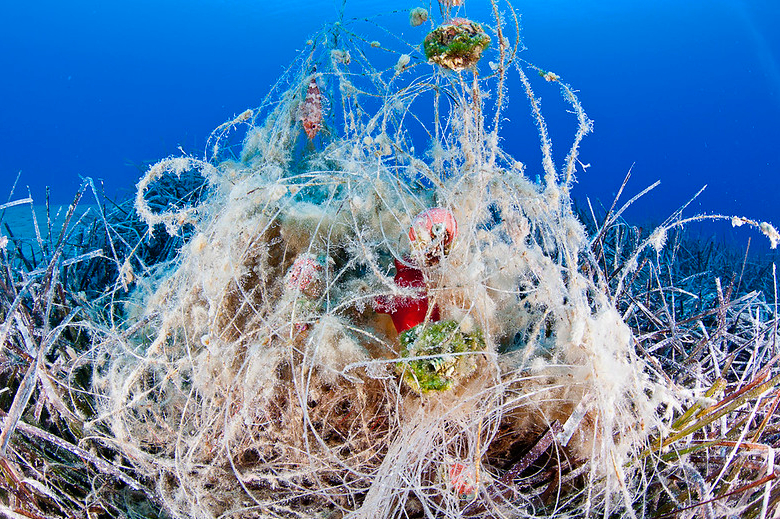
When people picture plastic pollution, they visualize water bottles and plastic straws. But for marine life, the most lethal hazard is ghost gear—commercial fishing nets, lines, and crab traps lost or discarded at sea.
Ghost gear makes up an estimated 10% of all ocean debris and accounts for up to 70% of floating microplastics larger than 20 centimeters. Because nets are made from resilient synthetic polymers, an abandoned net continues "fishing" autonomously for decades, entangling turtles, cetaceans, and seals in an endless cycle.
Plaintext
Lost / Abandoned Fishing Net ──> Entangles Fish & Marine Life ──> Attracts Scavengers ──> Scavengers Get Trapped ──> Sinks, Breaks, Continues Cycle
Over the past few years, the Global Ghost Gear Initiative (GGGI) and partner coalitions launched high-impact countermeasures:
Net Tagging & GPS Tracking: New fisheries regulations in major marine jurisdictions mandate gear marking using radio-frequency ID (RFID) tags and sonar beacons, holding boat operators accountable for lost nets.
Circular Net Upcycling: Direct buyout programs pay fishermen to bring worn-out nets back to port, where they are shredded and recycled into consumer goods ranging from high-performance skateboard decks to designer sunglasses.
Deep-Sea Retrieval Sweeps: Specialized dive teams and robotic underwater submersibles mapped and hauled up thousands of tons of legacy ghost nets from fragile submarine canyons, shipwrecks, and coral pinnacles.
Microplastics: Tackling the Invisible Enemy
Recent scientific breakthroughs focused heavily on the microscopic fragmentation of plastics:
Tire Dust & Synthetic Clothing: Filters on industrial wastewater treatment plants are increasingly engineered to catch microfiber runoff from home washing machines.
Biodegradable Alternatives: Algae-based, seaweed-derived bioplastics that naturally degrade in ambient seawater within weeks without leaving toxic residues are scaling up commercial production for packaging.
The journey toward a plastic-free ocean is far from over, but the shift from passive cleanup to aggressive upstream source-control represents the turning point the ocean needed.
Blue Carbon and Living Reefs — High-Tech Restoration and Innovative Marine Finance
Saving the ocean is no longer purely about building defenses; it’s about rolling up our sleeves and actively repairing what was broken.
Over the last few years, marine conservation crossed into a new era powered by biological innovation, high-tech coral breeding, and creative financial mechanisms that make ocean restoration economically irresistible.
Conservationists are leveraging the ocean's superpowers: coastal wetlands that sequester carbon faster than terrestrial rainforests, micro-fragmented corals that grow 40 times faster than in nature, and multi-million-dollar "debt-for-nature" swaps that wipe out national debt in exchange for permanent marine sanctuaries.
Here is how modern science and finance joined forces to revive the blue planet.
The Coral Renaissance: Assisted Evolution and Micro-Fragmentation
Rising sea surface temperatures have subjected coral reefs around the world to historic heat stress. In response, marine biologists stepped up active intervention programs using assisted evolution and micro-fragmentation.
Micro-Fragmentation: Pioneered by scientists at the Mote Marine Laboratory, researchers discovered that slicing coral polyps into tiny 1-millimeter pieces triggers an aggressive, rapid healing response. These micro-colonies grow up to 40 times faster than standard wild coral, allowing scientists to cultivate 50-year-old structures in a nursery in just a couple of years.
Selective Breeding for Heat Resilience: Scientists are identifying wild coral colonies that naturally survived intense marine heat waves (the "super-corals"), propagating them in temperature-controlled labs, and outplanting their larvae onto degraded reefs.
Larval Reseeding (Coral IVF): During mass synchronized spawning events, floating research stations collect billions of coral gametes, nurture them through their fragile larval phase in floating nurseries, and gently deposit millions of healthy larvae onto damaged reefs using underwater distribution rigs.
Blue Carbon: Coastal Ecosystems as Climate Superheroes
For decades, terrestrial forests received all the credit for carbon sequestration. But marine scientists proved that coastal blue carbon habitats—mangroves, seagrass meadows, and salt marshes—are the real champions of carbon storage.
The Sequestration Rate: A healthy mangrove forest or seagrass meadow can sequester carbon into seabed sediment up to 10 times faster per hectare than a mature tropical terrestrial rainforest.
Permanent Deep Storage: Unlike trees that release their carbon back into the atmosphere when they burn or rot, underwater sediments lack oxygen, locking carbon away for centuries or millennia.
Global Wetland Restoration: Mass restoration projects spanning Australia, Kenya, Colombia, and the Philippines restored thousands of hectares of coastal mangroves, simultaneously restoring local fish nurseries and buffering coastal homes from extreme storm surges.
Giant Kelp and Otter Alliances
In temperate coastal waters, underwater giant kelp forests were decimated over recent decades by marine heat waves and explosive population booms of purple sea urchins (which clear-cut kelp into barren underwater deserts).
Conservation efforts flipped the script:
Predator Reintroduction: Protecting and expanding sea otter populations along the North American Pacific Coast provided natural biological control over sea urchins, allowing historic kelp forests to bounce back within seasons.
Underwater Reforestation: Divers and robotic seeders now systematically clear urchin barrens and affix fast-growing kelp spores onto submerged rock reefs, sequestering massive amounts of carbon while rebuilding habitats for hundreds of fish species.
Innovative Finance: The Rise of the "Debt-for-Nature" Swap
One of the largest historical obstacles to conservation in developing island nations was simple economics: countries were drowning in national sovereign debt, leaving little to no budget for coastal enforcement and marine research.
Between 2021 and today, an ingenious financial model took center stage: Debt-for-Nature Swaps.
Nation
Financial Partner
Debt Restructured
Conservation Outcome
Belize (2021)
The Nature Conservancy
~$550 Million
Protected 30% of its ocean, including the world’s second-largest barrier reef.
Barbados (2022)
Inter-American Development Bank
~$150 Million
Created long-term trust funds to expand marine protection around the island.
Ecuador (2023)
US DFC / Inter-American Dev Bank
~$1.6 Billion
Guaranteed $450M in lifetime funding for the Hermandad Galápagos Reserve.
In these deals, environmental organizations and development banks buy back a country's foreign debt at a discount and reissue it with lower interest rates and longer repayment periods. In exchange, the savings are legally locked into an independent trust fund dedicated entirely to protecting, monitoring, and restoring the nation's marine reserves.
A Resilient Future
The narrative surrounding our oceans is shifting from despair to decisive action.
Through international legal frameworks, global satellite networks, cutting-edge restoration biology, and sovereign blue finance, the world is moving beyond simply observing ocean decline. The past six years proved that when scientific knowledge is backed by coordinated global effort, the oceans possess an extraordinary capacity to heal.