Turning Off the Tap — The Global Plastic Treaty and the Battle Against Ghost Gear
It is one of the most infamous statistics in environmental science: if humans continued on their business-as-usual trajectory, our oceans were projected to contain more plastic by weight than fish by 2050.
For decades, society’s approach to ocean plastic was akin to walking into a bathroom that is actively overflowing with water, handing out a few paper towels, and attempting to mop the floor while leaving the faucet running at full blast.
Beach cleanups are fantastic, but you cannot pick your way out of an exponential manufacturing surge.
Between 2020 and today, the global conservation movement fundamentally changed its strategy. The world moved beyond cleanup buckets to launch the UN Global Plastics Treaty, target industrial manufacturers, and systematically eliminate the deadliest plastic waste in the sea: abandoned "ghost gear."
The Watershed Moment: UNEA Resolution 5/2
In March 2022, the United Nations Environment Assembly (UNEA 5.2) convened in Nairobi, Kenya, and passed a historic, unanimous resolution: negotiate a legally binding global treaty to end plastic pollution.
Diplomats, environmental scientists, and civil society leaders launched the Intergovernmental Negotiating Committee (INC), conducting intensive global summits to build an international treaty covering the entire lifecycle of plastic.
- Targeting the Source: The treaty discussions moved past recycling and addressed raw polymer production caps, hazardous chemical additives, and mandatory phase-outs of single-use plastics.
- Standardized Packaging & Circular Economy: Mandating reusable packaging standards, minimum recycled-content thresholds, and extended producer responsibility (EPR) laws that hold manufacturers financially responsible for their products' end-of-life disposal.
- Financing Global Infrastructure: Creating dedicated environmental funds to help developing nations build modern waste collection and water treatment infrastructure before waste ever reaches river deltas.
Stopping the Bleeding: Interceptors and River Barriers
While diplomats write international law, engineers are physically intercepting plastic before it enters the sea.
Marine scientists established that approximately 80% of ocean plastic enters via roughly 1,000 major rivers worldwide. Stopping trash at the river mouth prevents it from fragmenting into microplastics across the open sea.
- Autonomous River Interceptors: Solar-powered, catamaran-style collection vessels deployed in heavy-flow river deltas in Indonesia, Malaysia, Vietnam, and Central America funnel floating debris onto conveyor belts, removing hundreds of tons of waste per month.
- Trash Traps and Bubble Curtains: Innovative low-cost barriers—including bubbling underwater air curtains that deflect plastic trash toward collection chutes without impeding migrating fish—are now standard in urban harbors from Amsterdam to Baltimore.
The Deadliest Threat: Hunting Down "Ghost Gear"
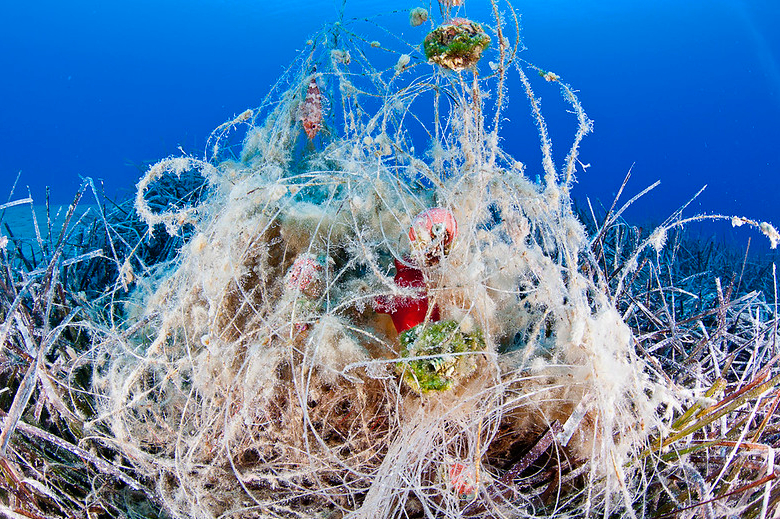
When people picture plastic pollution, they visualize water bottles and plastic straws. But for marine life, the most lethal hazard is ghost gear—commercial fishing nets, lines, and crab traps lost or discarded at sea.
Ghost gear makes up an estimated 10% of all ocean debris and accounts for up to 70% of floating microplastics larger than 20 centimeters. Because nets are made from resilient synthetic polymers, an abandoned net continues "fishing" autonomously for decades, entangling turtles, cetaceans, and seals in an endless cycle.
Plaintext
Lost / Abandoned Fishing Net ──> Entangles Fish & Marine Life ──> Attracts Scavengers ──> Scavengers Get Trapped ──> Sinks, Breaks, Continues Cycle
Over the past few years, the Global Ghost Gear Initiative (GGGI) and partner coalitions launched high-impact countermeasures:
- Net Tagging & GPS Tracking: New fisheries regulations in major marine jurisdictions mandate gear marking using radio-frequency ID (RFID) tags and sonar beacons, holding boat operators accountable for lost nets.
- Circular Net Upcycling: Direct buyout programs pay fishermen to bring worn-out nets back to port, where they are shredded and recycled into consumer goods ranging from high-performance skateboard decks to designer sunglasses.
- Deep-Sea Retrieval Sweeps: Specialized dive teams and robotic underwater submersibles mapped and hauled up thousands of tons of legacy ghost nets from fragile submarine canyons, shipwrecks, and coral pinnacles.
Microplastics: Tackling the Invisible Enemy
Recent scientific breakthroughs focused heavily on the microscopic fragmentation of plastics:
- Tire Dust & Synthetic Clothing: Filters on industrial wastewater treatment plants are increasingly engineered to catch microfiber runoff from home washing machines.
- Biodegradable Alternatives: Algae-based, seaweed-derived bioplastics that naturally degrade in ambient seawater within weeks without leaving toxic residues are scaling up commercial production for packaging.
The journey toward a plastic-free ocean is far from over, but the shift from passive cleanup to aggressive upstream source-control represents the turning point the ocean needed.