Living Neon — The Mind-Bending Science of Ocean Bioluminescence
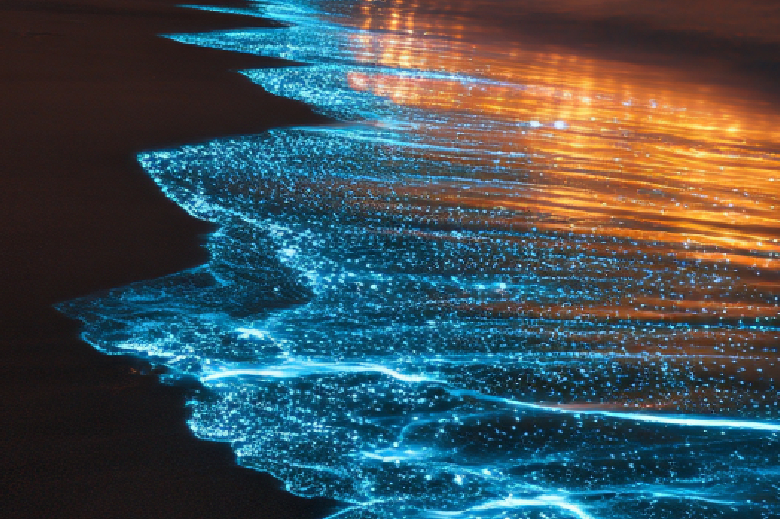
Step onto the right shoreline on a pitch-black, moonless night, and the sea might look like it was plugged directly into a wall outlet.
With every lapping wave, the surf flares electric blue. Dip your hand into the water, and your fingers trail ribbons of liquid starlight. Kick the wet sand, and it glitters like a disco ball.
This isn’t a special effect, and nobody dumped glowing dye into the water. You’re witnessing bioluminescence—one of the most surreal, sophisticated chemical tricks evolution ever pulled off.
While glowing creatures on land are rare novelties (think fireflies and a few peculiar mushrooms), bioluminescence in the ocean is the standard operating procedure. An estimated 75% to 90% of all deep-sea creatures make their own light.
Here is the brilliant chemistry, tactical warfare, and travel magic behind the ocean’s living glow.
The Spark: Cold-Light Chemistry 101
Human lightbulbs are terribly inefficient; they waste massive amounts of energy emitting heat. Nature figured out a much cooler design: chemiluminescence.
Biological light is nearly 100% efficient—producing almost zero radiant heat—via a simple two-part molecular recipe:
- The Substrate (Luciferin): A light-emitting pigment molecule (named after Lucifer, the Latin term for "light-bringer").
- The Engine (Luciferase): An enzyme that acts as a catalyst, sparking a reaction when it combines with oxygen and the luciferin.
- The Power Surge: When oxygen bonds to luciferin in the presence of luciferase, the molecule enters an excited energetic state. As it relaxes back to its baseline, it releases that excess energy as a single photon of visible light.
Why is almost all marine bioluminescence blue or green? Because blue light has the shortest wavelength and travels the farthest through water, while red light is absorbed and scattered almost immediately.
The Dinoflagellate Disco: Why Coastal Waves Light Up
When you see an entire bay or breaking wave glowing neon turquoise, you’re looking at millions of single-celled marine plankton called dinoflagellates (most commonly species like Pyrodinium bahamense or Noctiluca scintillans).
These tiny creatures light up for a fraction of a second when they feel mechanical stress—like the shear force of a breaking wave, the stroke of a kayak paddle, or a fish swimming nearby.
Why blow their cover? It's a tactical defense known as the "Burglar Alarm Hypothesis":
- A small crustacean or shrimp tries to eat the dinoflagellate.
- The plankton flashes like a strobe light.
- The flash blinds the grazer and illuminates it in the dark water.
- A larger predatory fish sees the illuminated grazer and snaps it up, effectively saving the plankton colony.
Tactical Glow: How Deep-Sea Creatures Use Light
In the pitch-black abyss of the bathypelagic zone (below 3,300 feet), light is the ultimate multipurpose multi-tool:
- The Deep-Sea Fishing Lure: The female Anglerfish sports an illicium—a fleshy spine protruding from its forehead tipped with a bulb full of glowing, symbiotic bacteria. Curious prey swim right up to inspect the midnight snack, straight into a mouth full of needle-sharp teeth.
- The Invisibility Cloak (Counterillumination): The Hatchetfish and Lanternfish have rows of glowing photophores on their bellies. By matching the intensity and color of their downward glow to the faint ambient sunlight filtering from above, they erase their silhouettes, making them invisible to predators lurking beneath them.
- The Smoke Screen: Deep-sea squid and glowing shrimp don’t shoot black ink (which is useless in the pitch black). Instead, they shoot a cloud of luminous, glowing mucus that temporarily blinds and confuses predators while the squid jets away into the darkness.
Chasing the Glow: The Best Bioluminescent Bays on Earth
To experience this firsthand, you need very specific conditions: warm, nutrient-rich, sheltered coastal lagoons with narrow outlets to the sea, visited during a New Moon (when skies are darkest).
| Destination | Location | What Makes It Special |
| Mosquito Bay | Vieques, Puerto Rico | Officially the brightest bioluminescent bay on Earth, packed with up to 700,000 dinoflagellates per gallon. |
| Luminous Lagoon | Falmouth, Jamaica | Extremely consistent, brilliant blue glow caused by unique brackish mangrove waters. |
| Grand Cayman Bio Bay | Cayman Islands | A sheltered, shallow inlet offering magical midnight glass-bottom kayak tours. |
| Bio Bay (Bahía Fosforescente) | Lajas, Puerto Rico | One of the classic bioluminescent locations with easy evening boat departures. |
Seeing the ocean ignite around your paddle is an experience that stays with you forever. It is an unforgettable reminder that nature is the greatest light show on earth.